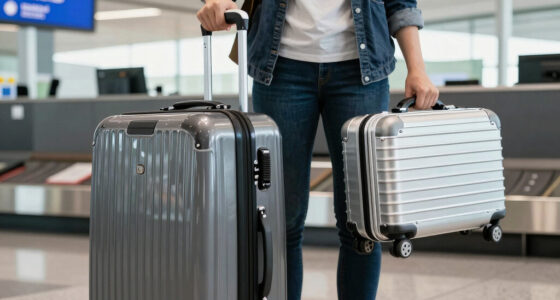
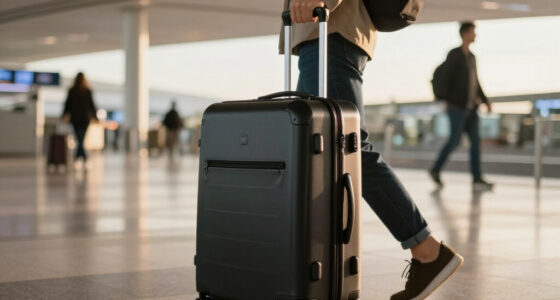
When comparing carry-on luggage with 20-inch wheels, the real choice is usually between a four-wheel spinner and a two-wheel roller. Both can suit short trips, but the wheel setup changes how the bag moves, how much room its mechanism takes, and how well it copes with uneven ground. A spinner turns easily through airport queues and narrow aisles; a two-wheel bag follows behind you and tends to roll more steadily over sidewalks and gaps. Choose a spinner if easy steering through terminals matters most. Choose a two-wheel carry-on if you often walk outdoors with your bag or want to favor usable packing space.

Get travel and outdoor gear delivered free with Prime
- Fast, free delivery on millions of items
- Prime Video, Amazon Music and more included
- Member-only deals all year

Sweetcrispy 20 Inch Carry On Luggage, Suitcase with Spinner Wheels
- ✔ Listed size: 20 inch
- ✔ Dimensions: 13 x 9 x 21.5 inches
- ✔ Capacity: 35 liters; expandable

LIGHT FLIGHT 20-Inch Carry-On Luggage, Royal Blue
- ✔ Listed size: 20 inch
- ✔ Dimensions: 21.4 x 14.6 x 9 inches
- ✔ Capacity: 35 liters; expands to 42 liters

Wrangler Hardside Spinner Carry-On Luggage, 20-Inch, Blue Heaven
- ✔ Listed size: 20 inch
- ✔ Dimensions: 14 x 9.5 x 22 inches
- ✔ Capacity: 38 liters
“20-inch” does not guarantee that a bag will meet every airline’s carry-on limit. Manufacturers may measure the body without wheels, while airlines generally count wheels and handles. Check the listed overall dimensions against your airline’s rules before buying, especially if you fly with strict size limits.
At a Glance
| Criteria | 20-inch spinner carry-on | 20-inch two-wheel carry-on | Winner |
|---|---|---|---|
| Steering in terminals | Turns in any direction; can roll beside you | Must be tilted and pulled behind you | A |
| Uneven ground | Small wheels can catch on cracks and rough pavement | Larger wheels generally handle rough paths and thresholds better | B |
| Usable packing space | Wheel housings can use some interior room | Often leaves more room inside the same exterior size | B |
| Stability and tipping | Can tip when pushed on two wheels or loaded unevenly | Usually tracks steadily when pulled | B |
| Wheel exposure | Four wheels extend beyond the case and can take impacts | Two recessed wheels are often more protected | B |
| Typical value | Available across budget and premium ranges | Available across budget and premium ranges | Depends |
| Airline fit | Depends on total outside dimensions, including wheels | Depends on total outside dimensions, including wheels | Tie |
Sweetcrispy 20 Inch Carry On Luggage, Suitcase with Spinner Wheels
Sweetcrispy earns the lead for travelers who want a more organized interior in a compact spinner. Its 35-liter capacity is on par with LIGHT FLIGHT’s unexpanded volume, but the included wet and dry mesh compartments and securing straps give belongings defined places. That setup is more useful for separating toiletries or damp items than LIGHT FLIGHT’s stated single main compartment. It also has expansion, although the supplied specifications do not give an expanded capacity, so we cannot compare its added room directly with LIGHT FLIGHT’s increase to 42 liters.The case weighs 6 pounds, the lightest of these three, which leaves a little more of a typical luggage weight allowance for packed items. Its 21.5-inch listed height is between LIGHT FLIGHT’s 21.4 inches and Wrangler’s 22 inches, but buyers should still compare the full dimensions with their airline’s limit. A TSA-approved lock is another practical advantage over Wrangler’s zipper lock. The tradeoffs: the shell is ABS, and the listed color is navy blue only. Choose it for compartmentalized packing; skip it if you want a specified expansion volume or broader color selection.
Pros:
- Wet and dry mesh compartments help keep different items apart.
- At 6 pounds, it is the lightest listed case in this comparison.
- Expandable storage and packing straps add packing flexibility.
- TSA-approved lock is specified.
Cons:
- Only navy blue is listed, limiting color choice.
- Expanded capacity is not specified, making its extra room hard to compare with LIGHT FLIGHT’s 42-liter figure.
- The ABS shell may not suit travelers seeking a different shell material.
Best for: Travelers who want a lightweight carry-on with separate wet and dry storage, packing straps, and a stated TSA-approved lock.
Not ideal for: Buyers who need a precisely stated expanded capacity, a range of color choices, or a shell material other than ABS.
Bottom line: We recommend Sweetcrispy for travelers who value divided packing and a specified TSA-approved lock more than a precisely quantified expansion.
“We recommend Sweetcrispy for travelers who value divided packing and a specified TSA-approved lock more than a precisely quantified expansion.”
LIGHT FLIGHT 20-Inch Carry-On Luggage, Royal Blue
LIGHT FLIGHT is the clearest fit for travelers whose packing needs vary between trips. Its stated capacity rises from 35 liters to 42 liters with 20% expansion, giving us a concrete comparison point that Sweetcrispy does not provide. That flexibility can help accommodate a few extra items on the return journey. The case also combines four spinner wheels with a four-level adjustable aluminum handle, and its five-year manufacturer warranty is a stated ownership feature that neither competing listing includes.There are meaningful compromises. At 6.8 pounds, it is the heaviest of these cases, 0.8 pounds above Sweetcrispy and 0.4 pounds above Wrangler. Its dimensions are 21.4 by 14.6 by 9 inches; that listed height is the shortest here, but the overall fit still depends on an airline’s size rules. The interior is described as a single main compartment, so it offers less specified separation than Sweetcrispy’s wet and dry mesh sections. Choose LIGHT FLIGHT if expansion is your priority; look to Sweetcrispy for more compartment detail or Wrangler for a lower listed weight and larger stated base capacity.
Pros:
- Expansion increases listed capacity from 35 to 42 liters.
- Four-level adjustable aluminum telescopic handle offers several height settings.
- Four 360-degree spinner wheels are specified.
- A five-year manufacturer warranty is listed.
Cons:
- At 6.8 pounds, it is the heaviest option in this comparison.
- The listed single main compartment offers less specified separation than Sweetcrispy.
- ABS composite may be less flexible than polycarbonate alternatives.
Best for: Travelers whose packing volume changes from trip to trip and who want a stated expansion from 35 to 42 liters.
Not ideal for: Those who prioritize the lowest carry-on weight or want multiple specified interior compartments for separating belongings.
Bottom line: We recommend LIGHT FLIGHT when a clearly stated 42-liter expanded capacity matters more than minimizing case weight or maximizing interior divisions.
“We recommend LIGHT FLIGHT when a clearly stated 42-liter expanded capacity matters more than minimizing case weight or maximizing interior divisions.”
Wrangler Hardside Spinner Carry-On Luggage, 20-Inch, Blue Heaven
Wrangler is the capacity-minded option if you want a comparatively light case without relying on an expansion claim. Its 38-liter listed capacity is greater than the 35-liter base capacities stated for Sweetcrispy and LIGHT FLIGHT, while its 6.4-pound weight sits between those two. The fully lined interior and compression straps are geared toward keeping clothes in place. Compared with Sweetcrispy, however, Wrangler’s listing does not describe separate wet and dry sections; compared with LIGHT FLIGHT, it does not give an expandable capacity.Its four spinner wheels suit the same rolling-first use as the other picks, but Wrangler’s dimensions are the largest listed by height at 22 inches. That makes a close check against airline limits especially sensible for overhead-bin travel. The main lock tradeoff is clearer still: Wrangler specifies a zipper lock, while Sweetcrispy and LIGHT FLIGHT list TSA-approved locks. Its shell is 100% ABS, and the description itself notes potential cracking under extreme pressure compared with polycarbonate. Choose Wrangler for its stated base capacity and compression straps; skip it if a TSA-approved built-in lock or a shorter listed height is central to your decision.
Pros:
- 38-liter listed capacity is the largest stated base capacity among these three.
- At 6.4 pounds, it is lighter than LIGHT FLIGHT.
- Compression straps help keep clothing secured inside.
- Four spinner wheels and padded carry handles are specified.
Cons:
- The zipper lock is not described as TSA-approved.
- At 22 inches tall, it has the greatest listed height in this comparison.
- ABS may be more vulnerable to cracking under extreme pressure than polycarbonate, according to the supplied description.
Best for: Travelers who want the largest stated base capacity in this group, compression straps, and a case lighter than LIGHT FLIGHT.
Not ideal for: Buyers who require a specified TSA-approved lock, want expandable capacity, or have a strict overhead-bin height limit.
Bottom line: We recommend Wrangler for travelers drawn to its 38-liter stated capacity and compression straps who can accept a zipper lock and 22-inch listed height.
“We recommend Wrangler for travelers drawn to its 38-liter stated capacity and compression straps who can accept a zipper lock and 22-inch listed height.”
As an Amazon Associate we earn from qualifying purchases.
Key Differences
The clearest day-to-day difference is how you move the bag. A spinner can pivot in place and roll next to you, which is handy in crowded terminals, elevators, and train aisles. That convenience is strongest on smooth surfaces. Its small wheels and exposed corners can be less forgiving on cobblestones, broken sidewalks, and deep carpet. A two-wheel roller needs a tilted pull, but its larger wheels often cope better with those changes in surface.
Two-wheel designs also tend to give more of the case’s interior to packing rather than wheel housings. The tradeoff is that the bag occupies space behind you while rolling, and pulling it for long distances can tire one arm. Spinners are easier to redirect and can reduce that strain in tight indoor spaces, though they may tip or roll away on a slope if left unattended. Neither wheel style guarantees a particular capacity or durability: construction, wheel quality, handle design, and how the bag is packed still matter.
Price alone does not decide which is better value. A well-built budget roller may serve occasional trips better than an expensive spinner that struggles on the traveler’s usual routes. Pay extra for sturdier wheels, a sound handle, and a useful warranty if the bag will see frequent travel. Before choosing either, compare full outside measurements with the airlines you use; a nominal 20-inch label may exclude wheels or handles.
Detailed Comparison
Steering in terminals (20-inch spinner carry-on wins — moderate)
The spinner wins; the gap is moderate. Four wheels let it turn sideways and roll beside you, so weaving through queues or maneuvering in a compact cabin takes less effort. The two-wheel case must be tilted and pulled behind you, which can be awkward when people are close or the aisle is narrow. If most of your travel is indoors on smooth flooring, the spinner’s handling advantage is meaningful.
Uneven ground (20-inch two-wheel carry-on wins — moderate)
The two-wheel carry-on wins; the gap is moderate. Its larger wheels often roll across sidewalk cracks, thresholds, and rougher pavement with fewer snags. Small spinner wheels can catch or vibrate on the same surfaces, and a bag may need to be lifted more often. The difference matters if a trip includes long walks between stations, taxis, or accommodations, though wheel size and build vary by model.
Usable packing space (20-inch two-wheel carry-on wins — minor)
The two-wheel design usually wins; the gap is minor to moderate. Recessed wheel assemblies can take up less of the interior than four spinner housings, leaving a little more room in a similarly sized shell. That can help when packing bulky clothes or keeping a small bag within a strict exterior limit. Actual capacity depends on the case’s shape, lining, pockets, and expansion, so compare stated dimensions and capacity rather than assuming every roller holds more.
Stability and tipping (20-inch two-wheel carry-on wins — minor)
The two-wheel carry-on has a modest edge; the gap is minor. When tilted and pulled, it generally tracks behind the traveler without relying on four small wheels standing upright. A spinner can tip if pushed on two wheels, loaded heavily on one side, or left on a slope; its free-rolling wheels may also move when parked. A balanced spinner remains perfectly workable, but travelers carrying fragile items may prefer the more predictable pull of a roller.
Wheel exposure and protection (20-inch two-wheel carry-on wins — minor)
The two-wheel design usually wins; the gap is minor. Rollers often tuck their two wheels partly into the case, where they may receive some protection from direct knocks. Spinner wheels sit at the corners and can be exposed to impacts during handling. This is a design tendency, not a guarantee: robust materials, replaceable wheel assemblies, and good construction matter more than wheel count alone. Check whether replacement parts are available if the bag will travel frequently.
Value for money (moderate difference)
There is no universal winner; the gap depends on use and build quality. Both wheel types are sold at budget and premium prices. Paying more for a spinner makes sense if its smooth maneuvering will save effort on frequent airport trips and the extra cost buys durable wheels and a reliable handle. A two-wheel case is better value for someone who prioritizes rough-ground rolling or packing room. For occasional trips, sound construction and a suitable warranty matter more than paying for a wheel style you rarely need.
Airline fit (major difference)
Neither wheel type wins; the gap is model-specific. Airlines set limits for the bag’s overall dimensions, and wheels and handles may count. The 20-inch label can describe the case body alone, so two bags with that label can have different outside measurements. Check the manufacturer’s full dimensions and your airline’s current rules before buying. A compact spinner may fit while a larger roller does not, or the reverse.
20-inch spinner carry-on: Pros and Cons
Pros:
- Easy to turn in crowded indoor spaces
- Can roll beside you without a constant tilted pull
- Convenient in queues, elevators, and train aisles
Cons:
- Small wheels may struggle on rough pavement
- Exposed corner wheels can take knocks
- May tip or drift when parked, depending on loading and slope
20-inch two-wheel carry-on: Pros and Cons
Pros:
- Often rolls more steadily over cracks and thresholds
- Recessed wheels can be better protected
- Wheel mechanism may leave more usable interior space
Cons:
- Must be tilted and pulled behind you
- Takes space behind you in crowded aisles
- Extended pulling can tire one arm
Who Should Choose What
Choose 20-inch spinner carry-on if:
- You spend most of your travel time in airports, stations, and hotels with smooth floors.
- You regularly maneuver through tight queues or narrow aisles.
- You value rolling the case beside you and can accept less sure handling on rough ground.
Choose 20-inch two-wheel carry-on if:
- Your trips include sidewalks, older streets, cobblestones, or frequent thresholds.
- You pull luggage for longer stretches and prefer a steady track.
- A little extra usable packing room or more protected wheels matters to you.
Skip both if: Skip both if your airline’s carry-on limits are smaller than the bags’ full outside dimensions, or if you need a larger checked suitcase for the amount you pack.
Value for Money
Pay more for a 20-inch spinner when you travel often through smooth, crowded terminals and the higher price buys dependable wheels, a sturdy telescoping handle, and a useful warranty. The reduced effort in tight indoor spaces can justify the premium for frequent flyers. If your routes include rough pavement or you want to maximize interior room, a well-made two-wheel carry-on is likely the better value, even at a similar price. Occasional travelers should favor reliable construction and airline fit over premium branding or extra features. Compare the full dimensions before paying, since a bag that does not meet your airline’s limit can cost more to check.
Final Verdict
For most travelers whose luggage use is mainly inside airports and hotels, choose a 20-inch spinner: it is easier to steer through crowds and narrow spaces. Choose the two-wheel carry-on if you often pull your bag outdoors, value steadier handling on rough surfaces, or want to favor packing space. The deciding factor is your route: smooth indoor travel favors the spinner, while uneven ground favors the roller. Before buying either, verify its overall dimensions, including wheels and handles, against the airlines you fly.
Frequently Asked Questions
Is a 20-inch carry-on small enough for every airline?
No. Airlines set their own limits, and the 20-inch label may exclude wheels and handles. Check the full outside dimensions against each airline’s current carry-on rules.
Are spinner wheels better than two wheels?
Spinner wheels are easier to steer on smooth indoor floors. Two-wheel bags often handle rougher ground more steadily and can have more protected wheels. The better choice depends on where you roll the case most.
Does a two-wheel carry-on hold more?
It often has less interior space taken up by wheel housings, but capacity depends on the entire design. Compare the stated capacity and interior dimensions of specific bags.
Is paying more for a spinner worth it?
It can be worthwhile for frequent travelers who regularly navigate crowded terminals and want easy steering. Pay the premium only when the bag also offers durable components and a warranty; occasional travelers may get better value from a sturdy, less expensive roller.