
TL;DR

Get travel and outdoor gear delivered free with Prime
- Fast, free delivery on millions of items
- Prime Video, Amazon Music and more included
- Member-only deals all year
Most airlines allow carry-ons around 22 x 14 x 9 inches and 15–22 pounds. Restrictions vary widely, so always check your airline’s policies before packing to avoid fees or gate-checks.
Imagine arriving at the gate, only to find your perfect carry-on is too big or too heavy. Suddenly, your smooth travel plans hit a snag. Understanding airline restrictions for carry-on size and weight isn’t just about rules—it’s about making sure your bag stays with you, not in the hold.
This guide walks you through the common limits, recent changes, and practical tips to pack efficiently. Knowing these details helps you breeze through check-in, avoid extra fees, and keep your trip stress-free.
Always measure and weigh your luggage at home before heading to the airport.
Check the specific airline’s size and weight limits—don’t assume generic standards apply.
Use a simple tape measure and luggage scale to verify compliance.
Be aware of exceptions for medical or musical items, but verify policies beforehand.
Stay updated on recent policy changes, especially with new tech and environmental pushes.
Understanding Airline Restrictions for Carry-On Size and Weight
TL;DR: Most airlines allow carry-ons around 22 × 14 × 9 inches and 15–22 pounds. There is no single global standard, so check the exact airline, route, fare class, and aircraft before packing.
About 56 × 36 × 23 cm, including wheels and handles.
Approximately 7–10 kg, with major variation by carrier.
Possible gate-check or excess-baggage fee when limits are exceeded.
The numbers most travelers should expect
Size limits protect overhead-bin capacity; weight limits support safe handling and efficient boarding. Treat these ranges as a planning baseline—not a guaranteed allowance.
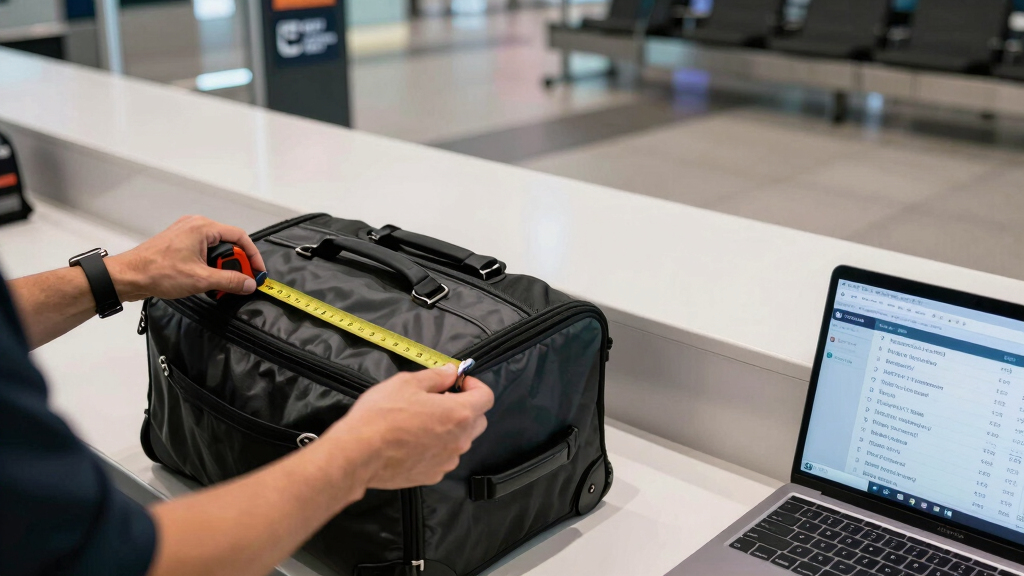
Measure the outermost points. Wheels, handles, pockets, protective feet, and bulging fabric all count toward the total dimensions.
International and low-cost carriers commonly enforce weight more closely. Some airlines publish no routine cabin-bag weight cap but still require passengers to lift bags safely.
One suitcase, four different outcomes
Published allowances differ by airline and may also change with route, cabin, fare, loyalty status, or aircraft. The comparison below illustrates why generic assumptions are risky.
| Airline | Size limit | Weight limit | Planning signal |
|---|---|---|---|
| American Airlines | 22 × 14 × 9 in | Policy-dependent | ✓Typical U.S. footprint |
| Ryanair | 22 × 16 × 8 in | 22 lb / 10 kg | Verify fare |
| Emirates | 22 × 15 × 8 in | 15 lb / 7 kg | ~Weight-sensitive |
| Southwest | 24 × 16 × 10 in | Policy-dependent | ✓Larger footprint |
Important: Airline policies can change, and allowances may differ by itinerary. Always use the airline’s current baggage page and your booking details as the final authority.
A four-step compliance check
Ten careful minutes at home can prevent repacking, fees, delays, and losing access to essentials during the flight.
Check all three sides
Record height, width, and depth at the bag’s widest points.
Count every fitting
Add wheels, handles, pockets, feet, and any expansion panels.
Test the packed bag
Use a luggage scale—or a reliable bathroom scale—after packing.
Match the booking
Check the airline, route, fare class, and personal-item allowance.
Five rules that reduce gate-day stress
Build a buffer into both dimensions and weight. Bags often expand after last-minute packing, and airport scales may differ slightly from the one at home.
Measure at home
Check the fully packed bag, not the empty shell.
Check the carrier
Never assume one airline’s allowance applies to another.
Use simple tools
Keep a tape measure and luggage scale nearby.
Confirm exceptions
Medical and musical items may need advance approval.
Recheck changes
Policies and enforcement technology continue to evolve.
Medical devices
Essential devices and medications may receive separate treatment. Carry documentation and contact the airline before travel.
Musical instruments
Cabin carriage may be possible even outside standard dimensions. Confirm storage and seating rules in advance.
Personal items
A purse or laptop bag is often allowed with a carry-on, but it must usually fit beneath the seat. Size still matters.
Why old packing habits may stop working
Enforcement is becoming faster and more consistent while airlines continue optimizing cabin space, boarding speed, ancillary fees, and fuel efficiency.
Automated sizing and weight checks
Gate scanners and advanced measurement tools can identify non-compliant baggage quickly, leaving less room for estimation.
Stricter low-cost enforcement
Ultra-low-cost fare models often separate personal-item and cabin-bag allowances, making fare details especially important.
A stronger push for lighter packing
Lower aircraft weight supports fuel efficiency, giving airlines an operational and environmental reason to encourage restraint.
What Are Typical Carry-On Size and Weight Limits? Expect These Numbers
Most airlines specify a maximum size of about 22 x 14 x 9 inches (56 x 36 x 23 cm), including handles and wheels. Weight limits usually hover between 15 to 22 pounds (7 to 10 kg). For example, a popular carry-on like the TravelPro Maxlite 5 measures 21.6 x 14 x 9 inches and weighs just 4.2 pounds, fitting comfortably within most limits.
Understanding these limits is crucial because exceeding them can result in gate-checking your bag, which may be inconvenient, or worse, incurring extra fees. The size limits are designed to ensure your bag fits in the overhead bin without obstructing others or causing delays. Weight limits are often set to prevent damage to aircraft storage compartments and to keep the process efficient. If your bag is too heavy, it can slow boarding and disembarkation, and in some cases, cause safety issues. Therefore, knowing these numbers helps you balance what to pack and what to leave behind, optimizing your carry-on for both convenience and compliance.
Check your airline’s website before packing. Some low-cost carriers like Ryanair stick to strict rules, while full-service airlines often have a bit more wiggle room. If you’re flying with a budget airline, don’t assume—measure your bag and weigh it at home first.
As an affiliate, we earn on qualifying purchases.
How to Measure Your Carry-On and Avoid Surprises
- Use a tape measure to check length, width, and height. Include wheels and handles, as these are part of the size restrictions. Remember, even a small extra inch can lead to gate-checking or fees, so precision matters.
- Weigh your bag with a luggage scale. Be honest—your bathroom scale can work if accurate. Understanding your bag’s weight before you get to the airport helps prevent last-minute surprises that could cause delays or extra charges.
- Compare your measurements to your airline’s limits. Double-check at least twice to ensure accuracy. If your bag is close to the limit, consider rearranging or removing non-essential items. This proactive step can save you time and money, especially during busy travel days.
For instance, a traveler packed a 22.5-inch hard-shell suitcase. At home, it fit the tape, but at the airport, it was slightly over the limit and had to be gate-checked, costing extra. Measuring early, and adjusting if necessary, avoids this hassle. It’s a small effort that pays off by preventing the inconvenience of last-minute repacking or unexpected fees, allowing you to focus on enjoying your trip instead of dealing with avoidable airport stress.
As an affiliate, we earn on qualifying purchases.
Compare Common Airline Carry-On Rules in a Clear Table
| Airline | Size Limit | Weight Limit | Notes |
|---|---|---|---|
| American Airlines | 22 x 14 x 9 inches | Up to 50 lbs (23 kg) | |
| Ryanair | 22 x 16 x 8 inches | 22 lbs (10 kg) | |
| Emirates | 22 x 15 x 8 inches | 15 lbs (7 kg) | |
| Southwest | 24 x 16 x 10 inches | Up to 50 lbs (23 kg) |
Notice the variation? While most stick close to 22 inches, some like Southwest are slightly bigger, giving you extra room for essentials or souvenirs. But weight limits often drop to 15 pounds with certain airlines, especially international ones, which can be a tradeoff—more space but less weight. Recognizing these differences allows you to plan your packing strategy accordingly, avoiding last-minute surprises or the need to leave items behind at the airport. It also emphasizes why it’s essential to check each airline’s policies, as assumptions based on one airline may not hold true for another, impacting your packing choices and overall travel experience.
As an affiliate, we earn on qualifying purchases.
What Happens If Your Carry-On Is Too Big or Heavy?
If your bag exceeds the airline’s limits, the staff might ask you to check it at the gate. This can be inconvenient, as gate-checked bags often get treated differently and may be subject to additional fees ranging from $50 to $200. The key implication is that non-compliance can lead to delays, extra costs, and even the risk of losing access to your bag during the flight if you’re not prepared.
Imagine squeezing into your seat, only to be told your bag must go into the hold. You might have to rearrange your belongings or pay extra. This situation can be stressful, especially if you’re in a hurry or have tight connections. To avoid this, measure and weigh your bag beforehand. It’s a small yet impactful step that ensures your packing aligns with airline policies, preventing last-minute surprises that could ruin your travel experience. Being proactive means you can focus on enjoying your journey rather than dealing with avoidable complications at the gate.
As an affiliate, we earn on qualifying purchases.
Are There Items That Get Special Treatment or Exemptions?
Yes. Medical devices, essential medications, and musical instruments often have exemptions because they are vital for your health or profession. For example, a musician flying with a violin might get special permission to carry it onboard, even if it exceeds normal size limits. This is because the value of these items goes beyond mere convenience—they are necessary for your well-being or livelihood. Always carry documentation, such as medical certificates or instrument permits, to verify your claims. This preparation helps avoid delays or denial of boarding, ensuring your essential items arrive with you and are not involuntarily checked or discarded. Recognizing these exemptions and preparing accordingly can make a significant difference in your travel experience, especially if you rely heavily on such items during your trip.
Similarly, a traveler with a wheelchair or oxygen tank can usually bring these items without penalty. The key is to communicate with airline staff ahead of time and verify policies. Doing so ensures a smoother process, minimizes stress, and guarantees you have what you need when you land.
How Recent Changes Impact Your Packing Strategy
Airlines are adopting new tech, like automated scanners, to verify size and weight faster, which means less tolerance for errors. Some carriers temporarily relaxed restrictions during the pandemic to accommodate increased passenger volume, but most are tightening enforcement now that travel normalizes. Additionally, environmental concerns are prompting airlines to encourage lighter packing to reduce fuel emissions, which can mean stricter limits or more rigorous checks. Staying updated on these changes is crucial because assumptions that worked last year may no longer apply. For example, ultra-low-cost carriers like Spirit or Frontier often have stricter, more rigid policies, and their enforcement can be more aggressive. Regularly reviewing airline websites and travel advisories before each trip ensures you’re aware of the latest policies, helping you pack appropriately and avoid surprises or additional fees. This proactive approach is essential for smooth travel in an evolving regulatory landscape.
Frequently Asked Questions
What are the typical size and weight limits for carry-on luggage?
Most airlines allow around 22 x 14 x 9 inches and 15–22 pounds. Always verify your airline’s policies before packing, as limits can vary widely.Can I bring a backpack and a purse as my carry-on items?
Yes, generally you can, as long as the combined size and weight stay within limits. Check your airline’s specific rules for personal items and packs.What happens if my carry-on exceeds the size or weight limit?
It may be gate-checked, and you could face extra fees, typically between $50 and $200. To avoid this, measure and weigh your bag beforehand.Are there any items exempt from restrictions?
Medical devices, musical instruments, or essential medications often have special allowances. Always carry documentation and check policies.How can I ensure my carry-on complies with airline restrictions?
Use a tape measure and luggage scale to verify dimensions and weight at home. Review your airline’s policies online before packing.Conclusion
Knowing the ins and outs of airline carry-on restrictions isn’t just about rules; it’s about reclaiming control over your travel experience. Pack smart, measure twice, weigh once—and avoid the hassle of gate surprises.
Picture yourself breezing through boarding, your bag fitting perfectly, your trip starting on a high note. That’s the power of understanding airline limits—make it your travel secret.
Fall Picks
fall essentials
As an affiliate, we earn on qualifying purchases.