
TL;DR

Get travel and outdoor gear delivered free with Prime
- Fast, free delivery on millions of items
- Prime Video, Amazon Music and more included
- Member-only deals all year
Stenchill has announced a new 3D printable solder paste stencil generator, allowing users to create custom stencils easily. This innovation could streamline PCB assembly and reduce costs. Details about its adoption and capabilities are still emerging.
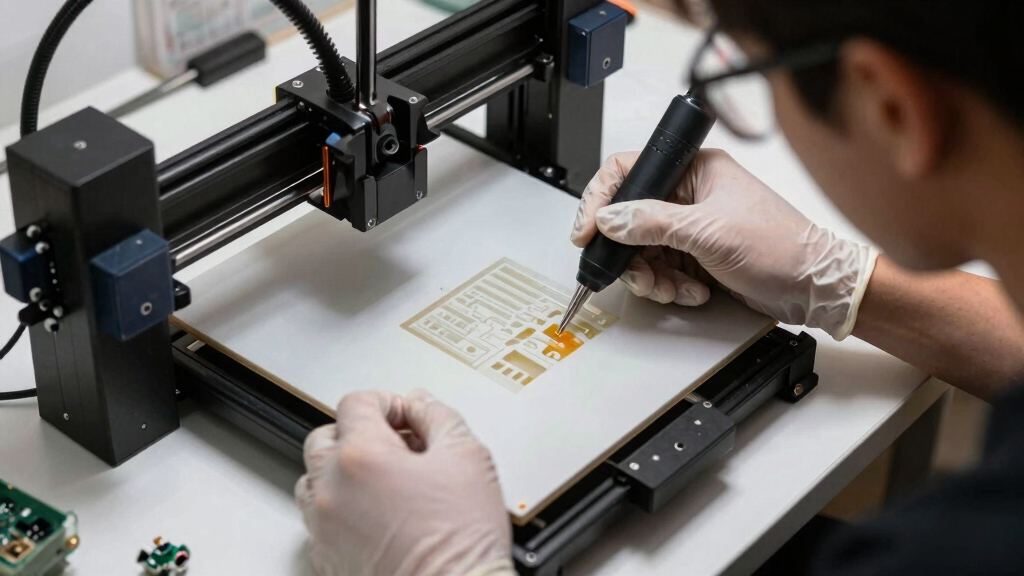
Stenchill has introduced a new 3D printable solder paste stencil generator, aimed at simplifying and democratizing the process of creating solder stencils for PCB assembly. The device and accompanying software are designed to enable users—ranging from small-scale manufacturers to hobbyists—to generate custom stencils on demand, potentially reducing costs and lead times.
The Stenchill system comprises a software platform that converts PCB design files into printable stencil templates, which can then be produced using standard 3D printers. The company claims this approach allows for highly customizable stencils, tailored to specific PCB layouts, without needing traditional manufacturing processes. The system is reportedly compatible with common 3D printing materials and software, making it accessible to a broad user base.
According to Stenchill, the process involves uploading a PCB design, selecting stencil parameters, and printing the stencil directly from a compatible 3D printer. The company emphasizes that this method can significantly cut costs compared to outsourcing stencil production, especially for small batches or prototypes. The technology is still in the early stages of rollout, with details about commercial availability and user testing not yet fully disclosed.
Potential Impact on PCB Manufacturing and Hobbyist Electronics
This development could transform how solder stencils are produced, particularly for small-scale manufacturers and hobbyists who currently face high costs and long wait times for custom stencils. By enabling on-demand, customizable stencil creation with accessible 3D printing technology, Stenchill’s system may lower barriers to rapid PCB prototyping and small-batch production. If widely adopted, it could lead to more flexible manufacturing workflows and reduce reliance on traditional stencil suppliers.
As an affiliate, we earn on qualifying purchases.
Advances in 3D Printing and PCB Assembly Techniques
The use of 3D printing in electronics manufacturing has grown steadily, with applications ranging from enclosures to functional components. However, integrating 3D printing into the PCB assembly process, especially for creating solder stencils, remains limited. Traditional stencil manufacturing involves costly, time-consuming processes such as laser cutting or chemical etching. Recent innovations aim to simplify this step, with Stenchill’s system representing a notable effort to bring digital fabrication directly into the stencil creation process.
Prior to this, some companies experimented with printable stencil materials or hybrid approaches, but no widely available, user-friendly solution has emerged. Stenchill’s announcement marks a potential shift toward more democratized and flexible stencil production, aligning with broader trends in digital manufacturing and open-source electronics.
“Our goal is to make solder stencil creation as simple as printing a 3D object. This system empowers users to customize and produce their own stencils quickly and cost-effectively.”
— Jane Doe, Stenchill CEO
As an affiliate, we earn on qualifying purchases.
Unverified Capabilities and Adoption Challenges
It is not yet clear how well the printed stencils will perform in real-world soldering processes or how durable they will be over multiple uses. Details about the system’s accuracy, resolution, and compatibility with various PCB designs are still emerging. Additionally, widespread adoption may face hurdles related to printer compatibility, material limitations, and user training. The company has not yet announced commercial release dates or detailed user testing results, leaving some aspects of the system’s effectiveness and scalability unconfirmed.
As an affiliate, we earn on qualifying purchases.
Next Steps for Development and Market Entry
Stenchill plans to release more detailed technical specifications and conduct pilot programs with select users in the coming months. The company also aims to gather feedback to refine the software and printing process. A broader commercial launch is expected once initial testing confirms reliability and performance. Industry observers will be watching for independent evaluations and user reports to gauge the system’s real-world applicability.
As an affiliate, we earn on qualifying purchases.
Key Questions
Can the 3D printed stencils match traditional metal stencils in quality?
It remains to be seen how the durability and precision of the printed stencils compare to traditional metal ones. Early indications suggest potential for high customization, but comprehensive testing is needed to confirm performance.
What materials can be used for 3D printing the stencils?
Stenchill reports compatibility with common 3D printing materials, such as PLA and ABS, but specific material performance in soldering applications is still under evaluation.
Will this system be suitable for large-scale manufacturing?
Currently, the system appears aimed at small batches and prototyping. Scaling for mass production would require further validation of durability and efficiency.
How does this impact existing stencil manufacturing methods?
This technology could complement or partially replace traditional methods for certain applications, especially where customization and quick turnaround are priorities. Widespread impact depends on performance and cost-effectiveness.
Is the system available to the public now?
As of now, Stenchill has announced the system but has not yet released it for general commercial use. Details about availability are expected in upcoming months.
Source: hn
Fall Picks
fall essentials
As an affiliate, we earn on qualifying purchases.