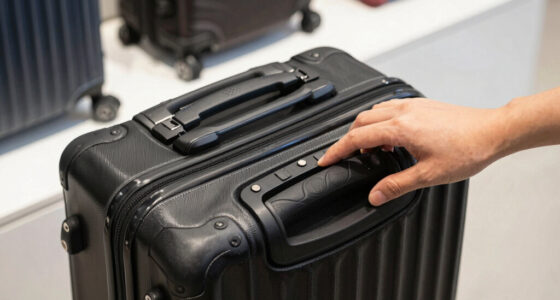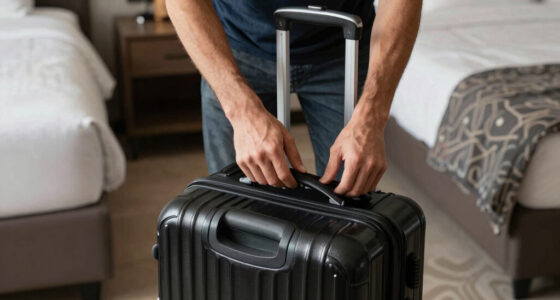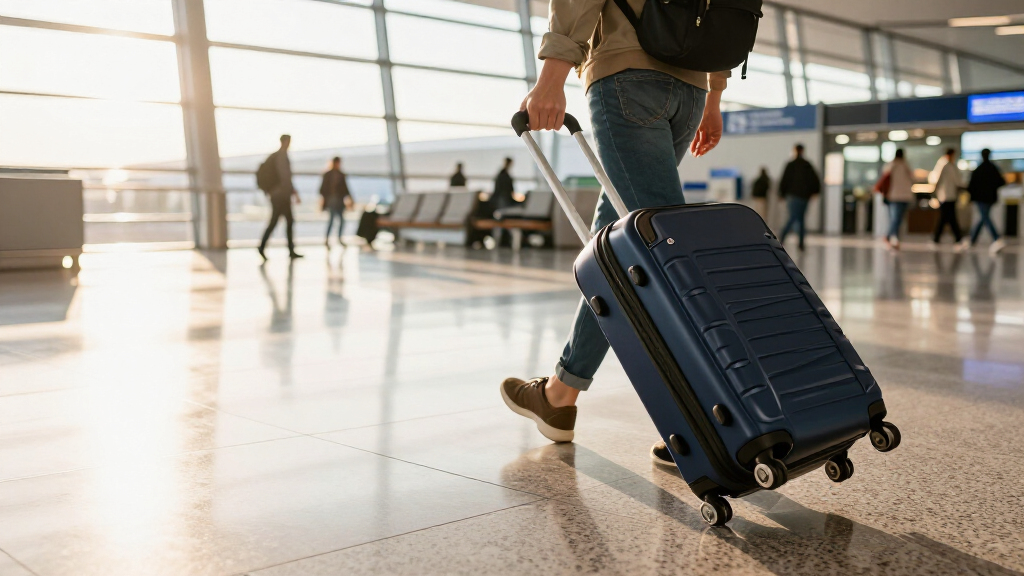

Choosing a carry-on with spinner wheels is really a choice between easy movement through airports and a bag that may be simpler to control on uneven routes. A four-wheel spinner rolls upright beside you and turns quickly in a crowded terminal; a two-wheel carry-on must be tilted and pulled, but its larger wheels are often better suited to cracked sidewalks and thresholds. The difference matters most when a bag is heavily packed, when you walk far with it, and when you need to fit it into an overhead bin.

Get travel and outdoor gear delivered free with Prime
- Fast, free delivery on millions of items
- Prime Video, Amazon Music and more included
- Member-only deals all year

LIGHT FLIGHT 20-Inch Carry-On Luggage, Royal Blue
- ✔ Dimensions: 14.6 × 9 × 21.4 in
- ✔ Weight: 6.8 lb
- ✔ Capacity: 35 L; expands to 42 L

Amazon Basics 21-Inch Expandable Hardside Carry-On Luggage with Spinner Wheels, Black
- ✔ Dimensions: 14.8 × 10 × 21.7 in, including wheels
- ✔ Item dimensions: 13.6 × 9.5 × 20.9 in
- ✔ Weight: 7.7 lb

Wrangler 22.5-Inch Hardside Spinner Carry-On Luggage, Black
- ✔ Dimensions: 22.5 × 13.75 × 8.5 in; listing notes conflicting carry-on dimensions
- ✔ Weight: 6.4 lb
- ✔ Storage volume: 38 L
This comparison focuses on the common decision between a four-wheel spinner and a two-wheel carry-on—not on a particular brand or model. Wheel quality, shell construction, dimensions, and warranty vary, so the category advantages are tendencies rather than guarantees. Choose the spinner for frequent airport travel on smooth surfaces and effortless steering. Choose two wheels if your route includes rough pavement, you prefer a trailing bag, or usable packing space and lower cost matter more than sideways mobility.
At a Glance
| Criteria | Four-wheel spinner carry-on | Two-wheel carry-on | Winner |
|---|---|---|---|
| Movement in airports | Moves upright and turns in any direction with little pulling effort. | Must be tilted and pulled; less convenient beside the traveler in crowds. | A |
| Rough-ground handling | Small wheels can catch on cracks, gravel, and uneven pavement. | Typically handles rough surfaces better when larger wheels are fitted. | B |
| Control and stability | Easy to steer beside the traveler, but can roll away on slopes. | Trails predictably when tilted, though pulling puts more load on the arm. | B |
| Packing capacity | Wheel housings take some space and reduce ground clearance. | Often offers more usable interior space and a flatter base. | B |
| Durability and repair exposure | Four exposed wheel assemblies create more potential impact points. | Two wheel assemblies mean fewer exposed components, though quality varies. | B |
| Price and value | Often costs more; extra convenience pays off for frequent smooth-floor travel. | Usually costs less, making it a strong choice for occasional trips. | B |
| Overhead-bin fit | Four wheels can add exterior height; check the complete packed dimensions. | Often has better clearance and a simpler shape, but dimensions still govern. | Depends |
LIGHT FLIGHT 20-Inch Carry-On Luggage, Royal Blue
For travelers who want one carry-on to cover a range of trips, the LIGHT FLIGHT 20-Inch makes the most balanced case in this group. Its stated capacity starts at 35 liters and expands to 42 liters, offering more flexibility than the Amazon Basics’ listed 32-liter capacity while keeping the bag at a lighter 6.8 pounds. That makes it a strong fit for a short trip when we want some extra packing room without choosing the heaviest option here.The TSA-approved combination lock is a meaningful differentiator: Amazon Basics has no built-in lock, and Wrangler lists one without specifying that it is TSA-approved. LIGHT FLIGHT also pairs compression straps and interior pockets with four silent 360-degree spinner wheels, combining basic packing control with easy direction changes in crowded spaces. These features make it the clearest all-round recommendation, although we should not confuse them with proof of long-term shell or wheel durability.Its main caution is familiar to expandable luggage: 42 liters is the expanded figure, and extra bulk may not suit every overhead bin. The listed dimensions are 14.6 × 9 × 21.4 inches, but airline rules vary, so we should check the carrier’s current limit rather than assume a 20-inch label guarantees acceptance. Compared with the Wrangler, LIGHT FLIGHT gives us more explicit security and expansion information; compared with Amazon Basics, it offers a lower listed weight and higher stated capacity. Choose it for that blend, not if exact airline compliance or a more compartment-heavy interior is the overriding concern.
Pros:
- Expands from 35 liters to 42 liters for flexible packing
- TSA-approved combination lock is specified
- 6.8-pound listed weight is lower than the Amazon Basics model
- Four silent 360-degree spinner wheels and compression straps
Cons:
- Expanded size may be less practical under strict cabin limits
- Airline carry-on limits vary despite the 20-inch size label
- Only two pockets are listed, fewer than the Amazon Basics model
Best for: Travelers who want an expandable carry-on with spinner wheels, a TSA-approved lock, and a lighter listed weight than the Amazon Basics model.
Not ideal for: Travelers who need guaranteed acceptance across airlines, a detailed interior with several zippered pockets, or a bag that stays at one fixed capacity.
Bottom line: We recommend LIGHT FLIGHT first for its combination of expandable capacity, relatively light weight, spinner wheels, and clearly specified TSA-approved lock.
“We recommend LIGHT FLIGHT first for its combination of expandable capacity, relatively light weight, spinner wheels, and clearly specified TSA-approved lock.”
Amazon Basics 21-Inch Expandable Hardside Carry-On Luggage with Spinner Wheels, Black
The Amazon Basics is the pick for travelers who want their belongings separated rather than packed into one large compartment. Its interior divider and three zippered pockets provide more defined storage than the two pockets listed for either competing bag. For chargers, toiletries, or small travel items, that layout can make it easier to keep essentials from shifting into the main clothing space. The shell is described as scratch-resistant, another practical point for frequent handling, though the supplied information does not establish how it holds up over time.It also expands by up to 25%, which can help when the return trip includes souvenirs or extra layers. This is a different kind of flexibility from simply choosing the largest base capacity: LIGHT FLIGHT states a larger capacity range, while the Amazon Basics makes expansion its headline packing feature. The tradeoff is weight. At 7.7 pounds, it is the heaviest option here, compared with 6.8 pounds for LIGHT FLIGHT and 6.4 for Wrangler. That extra starting weight leaves less of a weight buffer for belongings when airline limits apply.Four spinner wheels and a telescoping handle give it the same basic maneuverability approach as the others, but the model has no built-in lock. Its dimensions are listed as 14.8 × 10 × 21.7 inches including wheels, so we should compare those measurements with the airline’s actual carry-on rules. Water resistance is noted, but no level is specified; it should not be treated as a substitute for protection in heavy rain. Choose this model for its organized interior, not for the lightest load or built-in security.
Pros:
- Interior divider and three zippered pockets support organized packing
- Expands by up to 25% for additional room
- Scratch-resistant ABS hard shell is specified
- Four spinner wheels support multidirectional movement
Cons:
- Heaviest option listed at 7.7 pounds
- No built-in lock
- Water resistance level is not specified for heavy-rain conditions
Best for: Travelers who value a divider and multiple zippered pockets, and who want the option to expand packing space.
Not ideal for: Travelers prioritizing the lowest suitcase weight, a built-in lock, or a clearly stated capacity larger than the other options.
Bottom line: We would choose Amazon Basics when interior organization matters more than minimizing weight or having a built-in lock.
“We would choose Amazon Basics when interior organization matters more than minimizing weight or having a built-in lock.”
Wrangler 22.5-Inch Hardside Spinner Carry-On Luggage, Black
At 6.4 pounds, the Wrangler is the lightest carry-on in this comparison. That difference may matter to travelers trying to keep the suitcase itself from using up too much of an airline’s weight allowance, or to anyone who would rather lift a lighter bag into an overhead bin. Its 38-liter listed capacity is also substantial relative to the Amazon Basics’ listed 32 liters, although capacity figures are not always directly comparable across listings.For moving through the airport, Wrangler covers the essentials: four spinner wheels, a telescoping handle, and padded carry handles for lifting. Its fully lined interior and compression straps help keep clothing in place, while a built-in lock is listed. Compared with the Amazon Basics, Wrangler is lighter and has a specified lock; compared with LIGHT FLIGHT, it gives up explicit expansion information and a stated TSA-approved lock. This makes it a straightforward lightweight choice rather than the most feature-rich option.The central drawback is uncertainty about fit. The supplied listing reports dimensions of 22.5 × 13.75 × 8.5 inches, while the product name also calls it 22.5 inches; the available information flags conflicting carry-on dimensions. We should confirm the exact bag measurements, including wheels and handles, against the airline before relying on it as a cabin bag. Its 38-liter volume does not resolve that concern. Choose Wrangler if low listed weight and simple packing are priorities, but skip it if dependable size information or a specified TSA-approved lock matters more.
Pros:
- Lightest listed weight in this comparison at 6.4 pounds
- 38-liter listed storage volume
- Compression straps and fully lined interior
- Four spinner wheels, telescoping handle, and padded carry handles
Cons:
- Conflicting dimension information makes carry-on fit harder to verify
- Lock is listed, but TSA approval is not specified
- Expansion and detailed pocket layout are not clearly described
Best for: Travelers who put a low listed suitcase weight and compression straps ahead of expansion or extensive pocket organization.
Not ideal for: Travelers who need clearly consistent dimensions, explicit expansion details, or confirmation that the built-in lock is TSA-approved.
Bottom line: Wrangler is the best lightweight pick if its exact dimensions check out for our airline, but its sizing ambiguity keeps it behind the more clearly specified alternatives.
“Wrangler is the best lightweight pick if its exact dimensions check out for our airline, but its sizing ambiguity keeps it behind the more clearly specified alternatives.”
As an Amazon Associate we earn from qualifying purchases.
Key Differences
The spinner’s defining advantage is the way it moves: upright, beside you, and in multiple directions. That cuts down on the effort and space needed to steer through airport queues, hotel lobbies, and smooth station floors. For travelers who walk a long way inside terminals or frequently move through crowds, this is a meaningful daily convenience. The compromise is that spinner wheels are generally small and exposed. They can snag on uneven ground, and the bag may drift if left unattended on a slope.
A two-wheel carry-on takes more effort on smooth floors because it needs to be tilted and pulled. In return, larger wheels often roll more confidently over sidewalk seams and other rough patches, and the bag trails in a predictable line. Two-wheel designs can also leave more room inside and cost less. Neither wheel setup guarantees cabin acceptance or durability: the bag’s packed exterior dimensions, construction, wheel quality, and airline rules matter more than the label alone. The practical decision is whether airport agility is worth paying extra for, given where and how you travel.
Detailed Comparison
Movement in airports (Four-wheel spinner carry-on wins — major)
Four-wheel spinner wins; the gap is major for frequent terminal walking. It can roll upright alongside you and pivot around people or seats without a wide turning arc. This is especially useful when one hand is occupied or the aisle is crowded. A two-wheel bag has to be tilted and pulled, which takes more arm effort and usually occupies space behind or beside the traveler. If most of your journey is on polished airport floors, the spinner makes routine movement easier.
Rough-ground handling (Two-wheel carry-on wins — moderate)
Two wheels win; the gap is moderate and depends on wheel size. A two-wheel carry-on commonly uses larger wheels that can cross pavement cracks and shallow obstacles more smoothly. Spinner wheels are often smaller, and their swiveling mounts can catch or chatter on rough surfaces. Neither is ideal for deep gravel or stairs, but travelers who walk from a station over uneven sidewalks are less likely to be frustrated by a two-wheel design. A spinner remains workable if most rough patches are short.
Control and stability (moderate difference)
It depends on the route and how the bag is loaded. A tilted two-wheel bag trails in a fixed direction and is less prone to rolling away while in motion. The tradeoff is continuous pulling, which can tire the hand and shoulder. A spinner is easy to reposition and can be pushed or drawn beside you, but it may drift on a slope or when bumped. The difference is moderate: choose based on whether predictable trailing or low-effort steering better fits your habits.
Packing capacity (Two-wheel carry-on wins — minor)
Two wheels usually have a modest advantage. The wheel housings and extra wheel assemblies on a spinner can take up some space and may reduce the flat area at the base. Two-wheel cases often use a simpler underside and can provide a more regular interior shape. The actual difference varies by model, so compare stated capacity and usable compartments rather than assuming every two-wheel bag is roomier. This matters most to travelers who pack close to the carry-on limit.
Durability and repair exposure (Two-wheel carry-on wins — moderate)
Two wheels have a modest category advantage, not a guarantee of longer life. With four wheels there are more exposed assemblies that can be struck, snagged, or damaged in rough handling. A two-wheel bag has fewer wheel units and often places them partly under the case, though a damaged axle or poor-quality wheel can still end a trip early. Build quality, replacement parts, warranty terms, and how the bag is handled matter more than wheel count alone. If you travel often, inspect the wheel mounts and confirm whether repairs are supported.
Price and value (Two-wheel carry-on wins — moderate)
Two wheels usually win on purchase value; the difference is moderate. They are commonly available at lower prices, and their simpler setup can be a practical match for occasional trips. Paying more for a spinner makes sense when easy steering will be used on nearly every journey—especially across large terminals or with other bags in hand. For infrequent travel or a tight budget, the spinner premium may buy a convenience you rarely need. Compare the warranty and wheel replacement options before treating the cheapest bag as the best value.
Overhead-bin fit (moderate difference)
No category winner; dimensions decide. Spinner wheels can add to the bag’s exterior height, while a two-wheel case may offer more ground clearance or a simpler outline. But airlines measure the full bag, including wheels and handles, and permitted sizes differ by carrier. Check the packed exterior measurements against the airlines you use most, rather than relying on a general claim that a bag is carry-on sized. This is a major practical check for either option, even though the typical difference between wheel layouts is not enough to pick a winner.
Four-wheel spinner carry-on: Pros and Cons
Pros:
- Steers upright in any direction on smooth floors.
- Easy to pivot in crowded terminals and narrow aisles.
- Requires less continuous pulling effort.
- Can roll beside the traveler while a hand carries another item.
Cons:
- Small wheels can struggle with uneven sidewalks and rough surfaces.
- More exposed wheel assemblies can mean more points of impact or failure.
- May drift on slopes if not held.
- Wheel housings can take up space and add to exterior height.
Two-wheel carry-on: Pros and Cons
Pros:
- Often rolls over cracks and rough pavement more smoothly with larger wheels.
- Predictable trailing movement when tilted and pulled.
- Often provides more usable packing space for the same general size.
- Usually costs less and has fewer wheel assemblies.
Cons:
- Must be tilted and pulled rather than rolled upright beside you.
- Can take more arm and shoulder effort over long airport walks.
- Less nimble in crowded spaces and narrow aisles.
- Still requires checking wheel, axle, and warranty quality.
Who Should Choose What
Choose Four-wheel spinner carry-on if:
- You travel often through large airports with smooth floors and long connections.
- You want to steer the case beside you or turn it quickly in crowded queues.
- You carry another bag or need to keep one hand free while walking.
- You value low-effort movement enough to pay a reasonable premium.
Choose Two-wheel carry-on if:
- Your trips include sidewalks, station platforms, or other uneven surfaces.
- You prefer a bag that trails in a fixed direction when tilted.
- You want to maximize usable space or keep the purchase price down.
- You travel occasionally and do not need sideways airport maneuverability.
Skip both if: If your usual route involves stairs, sand, deep gravel, or long stretches without smooth rolling surfaces, consider a backpack or a carry-on with larger all-terrain wheels instead.
Value for Money
A spinner’s higher price is worthwhile when you will use its easy steering on most trips. Frequent flyers, travelers with long airport walks, and people managing a second bag are the clearest beneficiaries: reducing repeated pulling and tight turns can make each journey easier. For occasional travel, that premium is harder to justify when a two-wheel case can cost less, carry more effectively, and handle rough pavement well.
Do not judge value by wheel layout alone. A well-made two-wheel bag with a useful warranty can be a better buy than a cheap spinner with fragile mounts; a sturdy spinner may justify its cost for regular airport use. Compare full dimensions, weight, construction, repair support, and warranty coverage. Pay more for the spinner when airport maneuverability is a frequent need, not simply because four wheels sound more advanced.
Final Verdict
For most travelers whose trips are dominated by airports, a four-wheel spinner is the more convenient carry-on: it steers with less effort, turns quickly, and stays beside you in a crowd. Choose it if those advantages will matter on nearly every trip and the bag’s wheels and warranty justify the added cost. The biggest deciding factor is the surface you travel over.
Choose a two-wheel carry-on if your route includes uneven pavement, you want more usable packing space, or keeping the price down matters more than sideways steering. Its need to be tilted and pulled is a real drawback on long terminal walks, but it is not a reason to pay extra for a spinner if you rarely use that convenience. Before buying either, confirm the complete exterior dimensions against your airline’s cabin limits.
Frequently Asked Questions
Are spinner wheels better for a carry-on?
They are better for easy movement on smooth floors: a four-wheel case can roll upright and turn in multiple directions. They are not automatically better on rough pavement, where small spinner wheels may catch more readily than larger two-wheel models.
Do spinner wheels make a carry-on less durable?
Not necessarily. Four wheel assemblies create more exposed parts that may take impacts, but durability depends on wheel materials, mounts, case construction, handling, and repair support. Check warranty details and whether replacement wheels are available.
Which type is better for cobblestones or cracked sidewalks?
A two-wheel carry-on is often easier to pull across uneven ground because its wheels tend to be larger. Results vary by model, and neither standard design is comfortable on deep gravel, sand, or stairs.
Will a spinner carry-on fit in every overhead bin?
No. Airlines set different cabin limits, and the relevant measurement includes wheels and handles. Measure the packed exterior dimensions and check the rules for the carriers you use rather than relying on the product’s carry-on label.
Columbus Day / Indigenous Peoples' Day Picks
long weekend sales
As an affiliate, we earn on qualifying purchases.