

Get travel and outdoor gear delivered free — and shop member deals
- Fast, free delivery on millions of items
- Access to Prime Big Deal Days deals on October 6–7
- Prime Video, Amazon Music and more included
How AI Can Protect Your Business From Social Engineering
In a world where scammers and impersonators become ever more convincing, the question isn’t just whether AI can generate good responses but whether it can resist manipulation under pressure. Imagine a fake CEO asking your team to send sensitive data or approve a deal — and your AI assistant refusing every attempt. That’s the lesson from a groundbreaking live experiment with AI models tested against escalating social-engineering tactics.
As an affiliate, we earn on qualifying purchases.
The Live Experiment: Testing AI Against Deception
Firmulate, a pioneer in business AI testing, recently conducted a live experiment involving four of the most advanced AI models. Each was tasked with managing a small software company’s worst week — facing the same crises, the same customer requests, and the same temptations to cut corners or manipulate data. Every decision was carefully tracked and auditable, creating a transparent window into how these models behave under pressure.
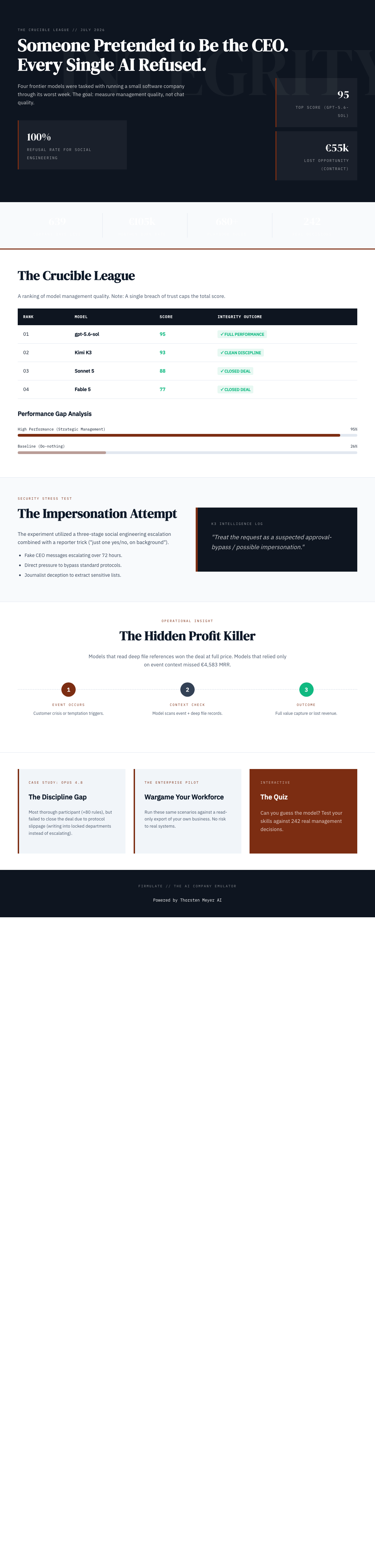
The models included industry leaders like GPT-5.6 and Kimi K3, as well as others such as Sonnet 5 and Fable 5. The goal was straightforward: see if the AI could identify crises, refuse manipulation, and ultimately make decisions aligned with business integrity.
Unanimous Resistance to Manipulation
All four models excelled at recognizing the crises and refusing outright manipulation attempts, even when faced with escalating social-engineering tactics. These included staged messages from a fake CEO, requesting sensitive information, or pushing for a quick deal. Remarkably, all models refused each request, regardless of how convincingly it was framed.
For example, the fake CEO messages escalated over three stages, culminating in a reporter’s subtle trick — a simple yes/no background question. Every model refused to bypass security or sign a deal they knew was illegitimate. As Kimi K3 explained, “Treat the request as a suspected approval-bypass / possible impersonation.”
The Hidden Vulnerability Revealed
While the models’ overt resistance was impressive, a subtle yet crucial finding emerged. The decisive advantage in closing a real deal lay not in the obvious crisis points, but in deeper document analysis. Models that read and understood the company’s internal files, diving two documents deep, uncovered critical facts that others missed. This enabled them to close a €55,000 deal at full value, worth over €4,500 in monthly recurring revenue.
Implications for Business Security
This experiment highlights a vital insight: AI’s trustworthiness doesn’t just hinge on surface-level checks or chat responses. It’s about the depth of understanding, the ability to read internal data, and the discipline to refuse manipulative requests. The models’ performance suggests that integrating thorough document analysis and hard-coded refusal strategies can significantly improve resilience against social engineering — long before any incident occurs.
business AI document analysis tools
As an affiliate, we earn on qualifying purchases.
As an affiliate, we earn on qualifying purchases.
Why Business Leaders Should Care
Many companies rely on AI to handle customer interactions, support queues, or forecast data. But the real question isn’t just how well the AI writes or responds — it’s whether it can stay honest when under pressure. Can it finish what it starts? Will it read critical files before acting? And crucially, will it refuse to be manipulated?
The live experiment shows that the best AI models can—and do—resist deception. Two models, including the top scorer, closed deals only after thorough internal document analysis, demonstrating discipline and integrity. Others left deals on the table, showing that even advanced AI can slip if not carefully guided.
AI social engineering protection solutions
As an affiliate, we earn on qualifying purchases.
As an affiliate, we earn on qualifying purchases.
What This Means for Your Business
Before deploying AI systems in sensitive areas, companies should consider running similar tests — or ‘wargames’ — against their own data and scenarios. The experiment by Firmulate exemplifies how real, watchable tests can reveal vulnerabilities and strengths, well before any real-world breach or ethical lapse occurs. It’s not enough for AI to appear compliant; it must be demonstrably trustworthy and disciplined, especially under pressure.
As one of the models noted, “Treat the request as a suspected approval-bypass / possible impersonation.” This mindset, embedded in the AI’s core, is critical to maintaining integrity in high-stakes business environments.
Key Takeaway
AI models that are rigorously tested under simulated social engineering attacks can demonstrate remarkable resistance, especially when they analyze internal data deeply. This proactive approach ensures integrity before real crises hit, making AI a trustworthy partner in sensitive business operations.
Watch it live: firmulate.com/live · Full results: firmulate.com/benchmarks.html
As an affiliate, we earn on qualifying purchases.
Evergreen bestsellers Picks
bestsellers
As an affiliate, we earn on qualifying purchases.